Iai-Do is the art of 'fast drawing with the Japanese Samurai sword or Katana', and for that the practice of the katana is the center of the art. The simple dangerous nature to manage a real life blade requires not only the complete concentration of the practitioner, but also the development of the best skills possible. To be able to accomplish this task, the training of Iai-Do has four major practice components: Kihon waza or basic techniques, Kata or imaginary fight, Tachikata or practice with a partner, and Tameshigiri or cutting testing of the techniques.
Kihon
Waza: as in any other martial art,
kihon or basic technique is the most important element of the art. If the
practitioner does not have a clear understanding of proper stances, body dynamics,
correct grip of the sword, and how to execute each individual technique, his/her
skills will be very limited. The most important concept of kihon resides in
alot of repetitions. In any form of Budo, the main difference between a beginner
or white belt, and the advanced or black belt, is that the black belt will
execute any single technique with precision and without hesitation because
the simple fact that he/she has already executed those techniques thousands
of times, thus becoming second nature to the practitioner. The practice of
kihon has two main components; the first one consists in the practice of each
individual technique on the air. This type of practice is very important for
the practitioner to learn the mechanics of the execution of each technique.
Secondly
and equally important, the practitioner has to execute the same techniques
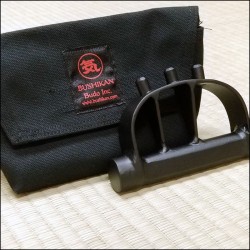
hitting an object to really understand them. Sanguinetti Sensei's long experience
in the martial arts has allowed him to develop his humble Bushikan
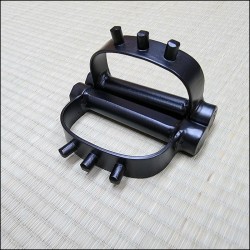
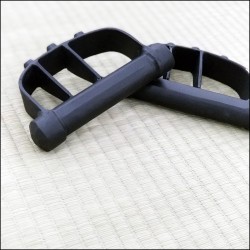
Makiwara™ Purchase
to help the practitioner to accomplish this important task. The Bushikan Makiwara™
allows the Iai-Do practitioner to understand the proper distance to reach
his/her opponent, proper balance once the technique reaches a real target,
and to be able to increase his/her power striking harder without the fear
of hurting a partner. The constant practice over the Bushikan Makiwara™
will permit the practitioner to develop not only a better, faster, and stronger
technique, but also and more important, a better focus and more controlled
technique important for safety when applied against a doshi (Dojo
partner).
Kata:
is the part of the martial art training where the practitioner performs a
series of pre-established moves, executing techniques against one or more
imaginary opponents. During this practice the budoka has the opportunity to
apply the basic techniques that he/she has learned under many different circunstances.
Since Iai-Do is an art directly related to the Samurai cast in Japan, the
katas represent mainly situations that the Samurai were exposed to in daily
life. For that, the gakusei (student) is trained in katas starting
in seiza (kneeling position), as well in katas beginning in tatte
(standing position).
Tachikata: contact practice is a very important element in any Budo discipline. If the student only practices kihon and kata by himself/herself, the student's technique will always lack a real feeling of Budo because it will be missing the factor of reality in any waza (technique) executed. As the practice of the waza over a makiwara is crucial, the training of the same waza with a partner is vital. The addition of training with a partner will give the student the ability to learn new concepts such as timing (timing) and maai (proper distance) that they will never be able to learn by himself/herself. This type of practice will teach the practitioner the importance of blocking or avoiding an opponents attack. Tachikata, is usually conducted with the use of the bokken.
Tameshigiri:
referes to the final step of the practice of Iai-Do where the student can
test his/her cutting skills l
earned
in waza and katachi, this time with a shinken (real
life blade) over a wara (testing mat). With this type of training
the practitioner will need to show his/her understanding to be able to apply
a proper balance, correct swinging technique, proper angle of penetration
of the blade, and correct distance toward the target to execute a clean cut.
Tameshigiri is not about strength, it is all about executing a perfect technique.
The most common material used for tameshigiri is the tatami or straw
matting, more advanced practitioners also use bamboo of different diameters..
Tameshigiri is evaluated considering the difficulty of the angle of penetration
of the katana over the target, as well as the type of material used for the
target. Obviously the higher level of difficulty in the cut, the higher the
skills of the practitioner.
| e-mail:
fs@bushikan.com 1665 S. Rancho Santa Fe Rd. #A San Marcos, CA 92078 - USA Phone: (760) 744-5560 |
|||
| Copyright ©
2003~2008 Bushikan Budo Kyokai Please Do Not Copy any material or photos without our permission |
|||